
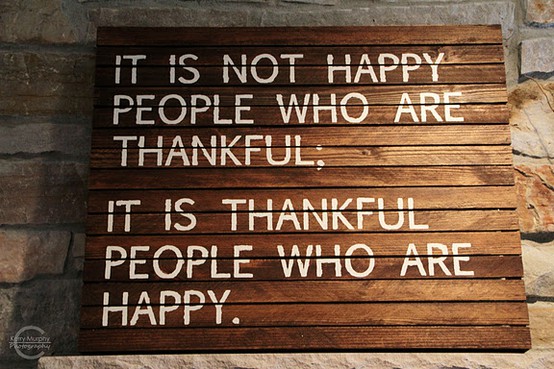
As I laid, lazy, full of turkey and whatever unbelievable amounts of food mixing in my stomach after one of the many large meals this weekend, I thought deep and hard about what Thanksgiving meant to me. The bizarre fact of which, of me even thinking about something profound when the majority of my metabolic capacity was probably diverted to the digestive organs, was nothing short of a miracle. The time spent with family and friends this time of the year was undoubtedly a blessing. A blessing with which many of us look forward to and enjoy. To eat heartily, to be merry, to be thankful. God is pleased I’m sure, because He is our provider and would have us enjoy the fruits of the harvest.
Amidst this enjoyment however, I can’t help but think about what it means to be thankful. The word is commonplace, we are taught, reminded even, when we were children to be thankful, not necessarily for lack of the sentiment sometimes, but because we forget. I find it kind, yet somewhat insincere, when my brother would remind my nieces to say “thank you” when I’ve given them something or did something for them. The irony of it all is that I recognize that I’m not much different from a child sometimes in my own lack of gratitude. I take, I receive, I consume, and sometimes I wish I had someone to remind me to stop: to receive with gratitude the gifts which which I am given. How much more the Father would be pleased, how much more the pleasure from the gift, if only I would do that.
Most self help books claiming to make you “happy” in 21 steps will inevitably invite you to be thankful. To take time to write down, perhaps in a journal daily or maybe weekly, a list of things (maybe 3 to 5, as if that’s all you can be thankful for) for which you are appreciative. Scientists who “studies” the psychology of happiness will have you believe that these habits will make a happier you. So let’s expound upon this process. If simply by writing down the things you are thankful for can make you happy, then it must follows that by being intentional about the things that you have (as opposed to your lacking) can indeed make you appreciate it more. So intentionality, leading to appreciation, contributing to happiness. When I first encountered the idea some years ago, I was astounded. Naturally, a “Thanks” journal was started, but slowly tapered off naturally with dishabit. I do not disagree with the idea or the habit, in fact I think it is a great idea because we do often need to be reminded, but just as when we taste the icing of a cake, we know there’s much more to the thing. Even a dull mirror reflect some light, after all.
Something in us knows that there’s much more to that. Happiness isn’t in a habit or a few steps. We want to believe it because it is convenient and even trivial. It has a hint of the Truth no doubt, but the matter as most has a deeper root, and when dealing with roots we go back to the heart. The adage and central theme: “the heart of the matter is the matter of the heart”. And, at least for me, the heart of the matter is this: if I have to think and scour the scope of my thoughts for things to be thankful for, I have forgotten what it means to be Christian. So I find Thanksgiving ought not to be just a Holiday, but a way of living. Christians would not find this contradictory because it is commanded, and like most commands when met with obedience, joy abounds.
Thanks be to God for his indescribable gift! 2 Cor 9:15
If that attitude is not apparent then one has not enjoy the book of Psalms, or the hopeful writing of the Apostle Paul. If one would stop to realize, to receive, the true redemption that comes from Christ, to gaze upon the cost of it, one would realize there’s no greater thing to be thankful for! The gospel therefore is not just for evangelizing or for teaching, but for relishing and enjoying, like a delicious honey ham, on a regular basis. Hypocrisy is a starving man, when in indescribable Abundance, tries to feed another human being.
Paul lamented that ALL things, the culmination of his life, of his past and future, all of it as dung (rubbish in a milder translation), that he may gain Christ (Philippians 3:8). Does that sound like a sad or starving man to you? But physically, we know that Paul suffered much physically as he writes this whilst in prison. If a man, who had been beaten, stoned, three times shipwrecked, and imprisoned, can write with such joy and gratefulness, who am I to have anything worth complaining of? Paul, in Philippians, explains it so beautifully the art of contentment, of true joy in Christ.
Presently, in the comfort of this Starbucks while sipping on my caramel brulee latte, I can’t help but feel a bit of guilt, a blush, not because there’s anything wrong with what I’m doing as I write this, but because that’s how I ought to feel! A child, now reminded! Thank you Jesus!
2 Consider it pure joy, my brothers, whenever you face trials of many kinds, 3 because you know that the testing of your faith develops perseverance. 4 Perseverance must finish its work so that you may be mature and complete, not lacking anything. James 1: 2-4
Alas, as Lewis often posits: the highs are never without the lows. We know this world we live in is in mutiny, it is in chaos (a topic for another day), yet the promises of the Lord gives us so much hope. A reading of Romans chapter 8 will challenge your thinking if you thought otherwise. James reminds us of that as well (amongst many other examples). We will face trials, we will suffer, we hurt, and will hurt others, but it is for our good. So then, in all things, good or bad, whether in peace or suffering, be thankful and consider it pure joy!
The truth sometimes is never real to us until we experience it in a life or death situation. CS Lewis knew a few things about suffering himself in his short book, A Grief Observed. I suppose one would not truly be able to understand the sentiment unless by primary exposure, but alas the point bitterly strong, like medicine. We take for granted this life, this reality, this time, the people in our lives. Life itself. On this point, I’ll stop here for fear of overstepping my bounds in writing about what it would be like to lose, so abruptly, someone so close to your heart, to your soul…
The truth is many people go without food, war, and diseases abound. The World Food Programme states that 842 million people in the world do not have food to eat and that:
Poor nutrition causes nearly half (45%) of deaths in children under five – 3.1 million children each year.
Being a critic of statistics, why would I even consider these numbers, because it reminds us of something rather important: 1) that we are sometimes so pathetically ungrateful because we know not the depth of lows or choose to ignore it altogether, and 2) because the Lord demands our grateful heart to grow in love and charity. To be the arms and feet of Him, to feed, clothe, comfort, love the least of these. As our hearts are filled with his love, as we proceed in Thanksgiving, as goodness takes root in our heart, let us not be like the 9 ungrateful lepers, who have been healed of our infirmities, redeemed by His death, and now alive, just go on our merry way as if nothing happened (Luke 17: 11-19). Let us be like the one leper who having been healed, ran in unimaginable gladness, probably throwing his hands in the air like an airplane flying, a bird freed, coming back to thank Him, giving glory to the healer, the LORD of the universe!
Jesus commands us to be thankful, to be joyful, to praise him, to eat, to drink, to give, to do all things to His glory! Thanksgiving is not a Holiday, it is the only rightful response of the redeemed.
 The Mountain's King